Showing posts with label Postcard Diary. Show all posts

Aug 16, 2020

Durdle Door | England


Last weekend we wanted to get  away from the heat, so we went to Dorchester. A friend told me about Durdle Door and we thought i would be nice to swim there! HUGE mistake. It was so unbelievably crowded that we didn't even get to the beach. We decided to go away. Deflated, on our way back, we saw a brown sign with the name 'Wimborne Minster' and decided to visit it. It turns out it is a cute little town with picturesque alleys and nice cafes in small piazzas. We will try to go back and spend a weekend!

Durdle Door (sometimes written Durdle Dor) is a natural limestone arch on the Jurassic Coast near Lulworth in Dorset. It is owned by the Welds, a family who own 12,000 acres (50 km2) in Dorset in the name of the Lulworth Estate. It is open to the public.

There is a dearth of early written records about the arch, though it has kept a name given to it probably over a thousand years ago. In the late 18th century there is a description of the "magnificent arch of Durdle-rock Door", and early 19th-century maps called it "Duddledoor" and "Durdle" or "Dudde Door". In 1811 the first Ordnance Survey map of the area named it as "Dirdale Door". Durdle is derived from the Old English thirl, meaning to pierce, bore or drill, which in turn derives from thyrel, meaning hole. Similar names in the region include Durlston Bay and Durlston Head further east, where a coastal stack suggests the existence of an earlier arch, and the Thurlestone, an arched rock in the neighbouring county of Devon to the west. The Door part of the name probably maintains its modern meaning, referring to the arched shape of the rock; in the late 19th century there is reference to it being called the "Barn-door", and is described as being "sufficiently high for a good-sized sailing boat to pass through it."


Jun 13, 2018

Rila Monastery | Bulgaria


A good friend sent me this postcard from Bulgaria on 1st November 2016. It shows Rila Monastery. I have not been in Bulgaria yet, but she tells me that I 'should really visit this place in autumn'. I will try dear V.

The Monastery of Saint Ivan of Rila, better known as the Rila Monastery (Bulgarian: Рилски манастир, Rilski manastir) is the largest and most famous Eastern Orthodox monastery in Bulgaria. It is situated in the southwestern Rila Mountains, 117 km (73 mi) south of the capital Sofia in the deep valley of the Rilska River at an elevation of 1,147 m (3,763 ft) above sea level, inside of Rila Monastery Nature Park. The monastery is named after its founder, the hermit Ivan of Rila (876 - 946 AD), and houses around 60 monks.

Founded in the 10th century, the Rila Monastery is regarded as one of Bulgaria's most important cultural, historical and architectural monuments and is a key tourist attraction for both Bulgaria and Southern Europe. In 2008 alone, it attracted 900,000 visitors. The monastery is depicted on the reverse of the 1 lev banknote, issued in 1999.


She used 2 stamps of 1 lev, 1 stamp of 0.20 lev and 1 stamp of 0.10 lev. 

10th FEBRUARY 2014, BULGARIA - Mushrooms; 0,10: Pine Bolete (Boletus pinophilus); 0,20: Magpie Fungus (Coprinus picaceus); 0,50: Citron Amanita (Amanita citrina); 1: Green-cracking Russula (Russula virescens)

Jun 10, 2017

Mount Pelion | Greece


Last week my parents went to amazing Pelion, Greece, and they send me these two postcards. I can honestly say that the colour of the sea is exactly like that in real life! Pelion or Pelium (Modern Greek: Πήλιο, Pílio; Ancient Greek/Katharevousa: Πήλιον. Pēlion) is a mountain at the southeastern part of Thessaly in central Greece, forming a hook-like peninsula between the Pagasetic Gulf and the Aegean Sea.


In Greek mythology, Mount Pelion (which took its name from the mythical king Peleus, father of Achilles) was the homeland of Chiron the Centaur, tutor of many ancient Greek heroes, such as Jason, Achilles, Theseus and Heracles. It was in Mount Pelion, near Chiron's cave, that the marriage of Thetis and Peleus took place. The uninvited goddess Eris, to take revenge for having been kept outside the party, brought a golden apple with the inscription "To the Fairest". The dispute that then arose between the goddesses Hera, Aphrodite and Athena resulted in events leading to the Trojan War. When the twins Otus and Ephialtes attempted to storm Olympus, they piled Mount Pelion upon Mount Ossa (this is the origin of the idiom, to "pile Pelion on Ossa").


They used a 0,80 euro stamp picturing Aristotle.

May 15, 2017

Nafplio | Greece

My parents visited Nafplio recently, one of the most picturesque Greek towns, and sent me these two beautiful postcards.


Nafplio (Modern Greek: Ναύπλιο) is a seaport town in the Peloponnese in Greece that has expanded up the hillsides near the north end of the Argolic Gulf. The town was an important seaport held under a succession of royal houses in the Middle Ages as part of the lordship of Argos and Nauplia, held initially by the de la Roche following the Fourth Crusade before coming under the Republic of Venice and, lastly, the Ottoman Empire. The town was the capital of the First Hellenic Republic and of the Kingdom of Greece, from the start of the Greek Revolution in 1821 until 1834. Nafplio is now the capital of the regional unit of Argolis.


The water castle of Bourtzi (Greek: Μπούρτζι, from Ottoman Turkish برج - burc meaning "tower"; formerly Καστέλι, Kasteli) is located in the middle of the harbour of Nafplio. The Venetians completed its fortification in 1473 to protect the city from pirates and invaders from the sea. The Greeks regained it from the Turks on June 18, 1822, from where they assisted in the siege of Nafplio. Until 1865 it served as a fortress. It was then transformed into residence of the executioners of convicts from the castle of Palamidi. From 1930 to 1970, it served as a hotel. Since then, it is mainly a tourist attraction hosting occasionally parts of the Summer Music Festival. [wikipedia]

May 8, 2017

Wales Millennium Centre | Wales


A couple of weeks ago, I visited the beautiful city of Cardiff and also went to Cardiff Bay. There I was really impressed by the Wales Millenium Centre (which you can see pictured on the above postcard).

Wales Millennium Centre (Welsh: Canolfan Mileniwm Cymru) is an arts centre located in the Cardiff Bay. The site covers a total area of 4.7 acres (1.9 ha). Phase 1 of the building was opened during the weekend of the 26–28 November 2004 and phase 2 opened on 22 January 2009 with an inaugural concert. The centre has hosted performances of Opera, ballet, Dance, Theater, comedy and Musicals.

The Centre comprises one large theatre and two smaller halls with shops, bars and restaurants. It houses the national orchestra and opera, dance, theatre and literature companies, a total of eight arts organisations in residence. It is also home to the Cardiff Bay Visitor Centre. The main theatre, the Donald Gordon Theatre, has 1,897 seats, the BBC Hoddinott Hall 350 and the Weston Studio Theatre 250. In 2001 Lord Rowe-Beddoe was appointed chairman of Wales Millennium Centre, a company limited by guarantee. Board members include Sir Michael Checkland. [wikipedia]

May 7, 2017

Burford | England


One of my favorite destinations in the UK is the Cotswolds. A few months ago I spent the weekend in Burford, one of the most picturesque English towns I have even visited.

Burford is a medieval town on the River Windrush in the Cotswold hills in West Oxfordshire, England. It is often referred to as the 'gateway' to the Cotswolds. The toponym derives from the Old English words burh meaning fortified town or hilltown and ford, the crossing of a river. The 2011 Census recorded the population of Burford parish as 1,410 and Burford Ward as 1,847.

Burford has twice had a bell-foundry: one run by the Neale family in the 17th century and the other run by the Bond family in the 19th and 20th centuries. Henry Neale was a bell-founder between 1627 and 1641 and also had a foundry at Somerford Keynes in Gloucestershire. Edward Neale had joined him as a bell-founder at Burford by 1635 and continued the business until 1685. Numerous Neale bells remain in use, including at St Britius, Brize Norton, St Mary's, Buscot, St James the Great, Fulbrook and SS Peter and Paul, Steeple Aston. A few Neale bells that are no longer rung are displayed in Burford parish church. 

Tilos | Greece


A couple of months ago, when I came home from work I had a pleasant surprise! A beloved friend has moved to Tilos island and sent me this beautiful postcard! She wrote that this is the view she has on her way to work (she teaches Greek to refugee children).

Tílos (Greek: Τήλος; ancient form: Telos) is a small Greek island and municipality located in the Aegean Sea. It is part of the Dodecanese group of islands, and lies midway between Kos and Rhodes. It has a population of 780 inhabitants (2011 census). Along with the uninhabited offshore islets of Antitilos and Gaidaros, it forms the Municipality of Tilos, which has a total land area of 64.525 square kilometres (24.913 sq mi). Tilos is part of the Rhodes regional unit.

Popularly, Telos was the son of Helios and Halia, the sister of the Telchines. He came to the island in search of herbs to heal his ill mother, and later returned to found a temple to Apollo and Neptune. However, Telos (Telo or Tilo) does not appear in Greek mythology and the name probably has an unknown pre-Hellenic origin. Pliny the Elder notes that in antiquity Telos was known as Agathussa (Αγαθούσσα) (also Agathusa and Agathousa). In the Middle Ages, it was known by the Italian as Episcopio, either because it was a Bishop Seat or because its position as Vantage Point. The island has also been called in Turkish İlyaki and in modern Italian Piscopi.


It was posted on 15 March 2017 and the stamp used pictures Aristotle. To mark the 2400th anniversary of the birth Aristotle, who was born in 384 BCE, Hellenic Post issued a commemorative set of stamps to honour his invaluable contribution to humanity. The works of the great Macedonian philosopher of antiquity, the student of Plato and the tutor of Alexander the Great, unique in range and influence in the history of human thought, are an integral and essential part of world cultural heritage.

This is the thinking behind UNESCO proclaiming 2016 “Aristotle Anniversary Year”, an initiative of the Interdisciplinary Centre for Aristotle Studies at the University of Thessaloniki, implemented by the Greek National Commission for UNESCO.

Apr 24, 2017

Land's End | England

I recently went to Land's End in Cornwall (England) with some friends. I was blown away by the beautiful scenery.

Land's End (Cornish: Penn an Wlas or Pedn an Wlas) is a headland and holiday complex in western Cornwall, England. It is the most westerly point of mainland Cornwall and England, is within the Penwith peninsula and is about eight miles (13 km) west-south-west of Penzance at the western end of the A30 road.

Oct 10, 2015

Planet Island | Greece


This is one of the postcards my parents sent me. It shows Planitis island near Tinos, Greece. Planitis  [Greek : Πλανήτης, which means planet] is an almost rocky Greek island with a dilapidated lighthouse on its summit. It is joined with Kavalurko beach by small rocks, which form small narrows, called Diapori connecting the bay with the open sea (Aegean Sea). On Planitis there used to be a marble mine, but nowadays one can meet only wild rabbits instead of miners.

The lighthouse first functioned in the year 1886. It marks the harbor of Panormos, the only harbor in the north –for this is also important for fishermen.The altitude of tower is 8 metres and the height of focal plane is 85 metres. 

Tinos Island | Greece

A few weeks ago my parents went to the beautiful island of Tinos in Greece and they sent me these postcards. They were mesmerized by the picturesque villages and the amazing beaches.

Tinos (Greek: Τήνος) is a Greek island situated in the Aegean Sea. It is located in the Cyclades archipelago. In antiquity, Tinos was also known as Ophiussa (from ophis, Greek for snake) and Hydroessa (from hydor, Greek for water). The closest islands are Andros, Delos, and Mykonos. It has a land area of approximately 194 square kilometres (75 sq mi) and a 2011 census population of 8,636 inhabitants.

Tinos is famous amongst Greeks for the Church of Panagia Evangelistria, its 80 or so windmills, about 1000 artistic dovecotes, 50 active villages and its Venetian fortifications at the mountain, Exomvourgo. On Tinos, both Greek Orthodox and Roman Catholic populations co-exist, and the island is also well known for its famous sculptors and painters, such as Nikolaos Gysis, Yannoulis Chalepas and Nikiforos Lytras.

The island is located near the geographical center of the Cyclades island complex, and because of the Panagia Evangelistria church, with its reputedly miraculous icon of Virgin Mary that it holds, Tinos is also the center of a yearly pilgrimage that takes place on the date of the Dormition of the Virgin Mary (15 August, "Dekapentavgoustos" in Greek). This is perhaps the most notable and still active yearly pilgrimage in the region of the eastern Mediterranean. Many pilgrims make their way the 800 metres from the ferry wharf to the church on their hands and knees as sign of devotion. [wikipedia]


Sep 19, 2015

Astypalaia | Greece


This postcard was sent by some very dear friends who traveled in the Greek island of Astypalaia, which means Old City in Greek. Astypalaia (Greek: Αστυπάλαια), called in Italian Stampalia and in Ottoman Turkish İstanbulya (استانبوليه), is a Greek island with 1,334 residents (2011 census). It belongs to the Dodecanese, an island group of twelve major islands in the southeastern Aegean Sea. The island is 18 kilometres (11 miles) long, 13 kilometres (8 miles) wide at the most, and covers an area of 97 km2. Along with numerous smaller uninhabited offshore islets (the largest of which are Sýrna and Ofidoussa), it forms the Municipality of Astypalaia. Astypalaia is part of the Kalymnos regional unit.

In Greek mythology, Astypalaia was a woman abducted by Poseidon in the form of a winged fish-tailed leopard. The island was colonized by Megara or possibly Epidaurus, and its governing system and buildings are known from numerous inscriptions. Pliny the Elder records that Rome accorded Astypalaia the status of a free state. [wikipedia]


Aug 15, 2015

Lovely Kingston upon Thames | England


I live in Kingston upon Thames for almost 2 years now, and this is the first time I find a postcard of Kingston. It is a multiview [in clockwise order]: 

  • Kingston Bridge is a road bridge at Kingston upon Thames in London, carrying the A308 across the River Thames. It joins the town centre of Kingston in the Royal Borough of Kingston upon Thames, to Hampton Court Park, Bushy Park, and the village of Hampton Wick in the London Borough of Richmond upon Thames. As of 2005, it carried approximately 50,000 vehicles per day with up to 2,000 vehicles per hour in each direction during peak times. Kingston Bridge is on the reach above Teddington Lock and close to and downstream of the mouth of the Hogsmill River, a minor tributary of the Thames. It is on the route of the Thames Path and is the end point for the Thames Down Link long distance footpath from Box Hill station.
  • A Tudor style building next to Everyday Church
  • The waterway
  • The City Center
  • 'Out of Order' sculpture, created by David Mach. David Mach (born in Methil, Fife, on 18 March 1956) is a Scottish sculptor and installation artist. Mach's artistic style is based on flowing assemblages of mass-produced objects. Typically these include magazines, vicious teddy bears, newspapers, car tyres, match sticks and coat hangers. Many of his installations are temporary and constructed in public spaces.
  • A view of the River Thames from Kingston Bridge
  • Bentalls Shopping Center
  • Hampton Court Palace

Aug 14, 2015

A cow in Limburg | Netherlands

This postcard was sent to me by a friend who lives in Limburg, in the Netherlands.
Limburg is the southernmost of the 12 provinces of the Netherlands. It is in the southeastern part of the country and borders the provinces of Gelderland to the north and North Brabant to the north and the northwest. To the east it borders the German state of Northrhine-Westphalia, to the west the Flemish province of Limburg, and to the south the Walloon province of Liège.

Limburg's major cities are the provincial capital Maastricht in the south, Roermond in the middle, and Venlo in the north, all upon the Meuse river. In South Limburg, there are also urban agglomerations at Sittard-Geleen and Parkstad Limburg, which includes the city of Heerlen.

Limburg has a highly distinctive character. The social and economic trends that affected the province in recent decades generated a process of change and renewal which has enabled Limburg to transform its peripheral location into a highly globalized regional nexus, linking the Netherlands to the Ruhr metro area and the southern part of the Benelux region. A less appreciated consequence of this international gateway location is rising international crime, often drug-related, especially in the southernmost part of the province.
[wikipedia]

Aug 2, 2015

In the lap of Himalayas | India

I am trying to catchup with all the postacards I have received and bought the whole time I had 'paused' this blog. This one was sent from a very dear friend when he visited India in November 2014.

It shows Shimla,  or in British Indian orthography, Simla, the capital of the Indian state of Himachal Pradesh, located in northern India. Shimla acts as a hub for India's tourism sector. It is among the top 10 preferred entrepreneurial locations in India. In 1864, Shimla was declared as the summer capital of British India, succeeding Murree, northeast of Rawalpindi. After independence, the city became the capital of Punjab and was later named the capital of Himachal Pradesh.

After the reorganisation, the Mahasu district and its major portion was merged with Shimla. Its name is derived from the goddess Shyamala Devi, an incarnation of the Hindu goddess Kali. As of 2011 Shimla comprises 19 hill states; mainly Balson, Bushahr, Bhaji and Koti, Darkoti, Tharoch & Dhadi, Kumharsain, Khaneti & Delath, Dhami, Jubbal, Keothal, Madhan, Rawingarh, Ratesh, and Sangri.

Shimla is home to a number of colleges and research institutions as well as multiple temples and palaces. The city's buildings are styled in the Tudorbethan and neo-Gothic architectures dating from the colonial era. Owing to its steep terrain, Shimla hosts the mountain biking race MTB Himalaya, which started in 2005 and is regarded as the biggest event of its kind in South Asia.

Himachal Pradesh (literally "Snow-ladden Region") is bordered by Jammu and Kashmir on the north, Punjab on the west, Haryana on the south-west, Uttarakhand on the south-east and by the Tibet Autonomous Region on the east.

Himachal Pradesh is famous for its abundant natural beauty. After the war between Nepal and Britain, also known as the Anglo-Gorkha War (1814–1816), the British colonial government came into power. In 1950 Himachal was declared a union territory, but after the State of Himachal Pradesh Act 1971, Himachal emerged as the 18th state of the Republic of India. Hima means snow in Sanskrit, and the literal meaning of the state's name is In the lap of Himalayas. It was named by Acharya Diwakar Datt Sharma, one of the great Sanskrit scholars of Himachal Pradesh.

The economy of Himachal Pradesh is currently the third fastest growing economy in India. Himachal Pradesh has been ranked fourth in the list of the highest per capita incomes of Indian states. This has made Himachal Pradesh one of the most wealthiest places in entire South Asia. Abundance of perennial rivers enables Himachal to sell hydroelectricity to other states such as Delhi, Punjab and Rajasthan. The economy of the state is highly dependent on three sources: hydroelectric power, tourism and agriculture.

Himachal Pradesh is spread across valleys and 90% of the population lives in villages and towns. However the state has achieved 100% hygiene and practically no single house without a toilet. The villages are well connected to roads, Public Health Center and now with Lokmitra kendra using High speed broadband. Shimla district has maximum urban population of 25%. According to a 2005 Transparency International survey, Himachal Pradesh is ranked the second-least corrupt state in the country after Kerala. The hill stations of the state are among the most visited places in country. The government has successfully imposed environmental protection and tourism development meeting European standards and it is the only state which forbids the use of polythene and tobacco products. [wikipedia]

The card was posted with a Indira Ghandi and a Mother Teresa stamp.

Venezia, the Floating City | Italy

Last year some friends did a small tour in Italy and sent me a postcard from every city they visited [thank you, guys]. I only found time now [one year later, shame on me] to upload them. This one is from Venice. 

Venice (Italian: Venezia, alternative obsolete form: Vinegia; Venetian: Venesia; Latin: Venetiae; Slovene: Benetke) is a city in northeastern Italy sited on a group of 118 small islands separated by canals and linked by bridges. It is located in the marshy Venetian Lagoon which stretches along the shoreline, between the mouths of the Po and the Piave Rivers. Venice is renowned for the beauty of its setting, its architecture, and its artwork. The city in its entirety is listed as a World Heritage Site, along with its lagoon.[

Venice is the capital of the Veneto region. In 2009, there were 270,098 people residing in Venice's comune (the population estimate of 272,000 inhabitants includes the population of the whole Comune of Venezia; around 60,000 in the historic city of Venice (Centro storico); 176,000 in Terraferma (the Mainland), mostly in the large frazioni (roughly equivalent to "parishes" or "wards" in other countries) of Mestre and Marghera; 31,000 live on other islands in the lagoon). Together with Padua and Treviso, the city is included in the Padua-Treviso-Venice Metropolitan Area (PATREVE), with a total population of 2,600,000. PATREVE is only a statistical metropolitan area without any degree of autonomy.

The name is derived from the ancient Veneti people who inhabited the region by the 10th century BC. The city historically was the capital of the Republic of Venice. Venice has been known as the "La Dominante", "Serenissima", "Queen of the Adriatic", "City of Water", "City of Masks", "City of Bridges", "The Floating City", and "City of Canals". Luigi Barzini described it in The New York Times as "undoubtedly the most beautiful city built by man". 
The Republic of Venice was a major maritime power during the Middle Ages and Renaissance, and a staging area for the Crusades and the Battle of Lepanto, as well as a very important center of commerce (especially silk, grain, and spice) and art in the 13th century up to the end of the 17th century. This made Venice a wealthy city throughout most of its history. It is also known for its several important artistic movements, especially the Renaissance period. Venice has played an important role in the history of symphonic and operatic music, and it is the birthplace of Antonio Vivaldi. [wikipedia]

Jul 26, 2015

Bath spa | England

Wow. It's been 3 years since I last wrote on this blog. Unfortunately the Greek crisis brought my life upside down so I couldn't devote any time on my post cards. Now, 3 years later, I live in another country and my life is almost normal again. So I can do what I love most: travel!
I went to the amazing city of Bath. Bath is a city in Somerset, South West England, that is known for the curative Roman-built baths that still exist there. In 2011, its population was 88,859. It became part of Avon in 1974; since Avon's abolition in 1996, it has been the principal centre of Bath and North East Somerset. The city, in the valley of the River Avon, became a UNESCO World Heritage Site in 1987.
 
The city became a spa with the Latin name Aquae Sulis ("the waters of Sulis") c. AD 60 when the Romans built baths and a temple in the valley of the River Avon, although oral tradition suggests that the hot springs were known before then.

Nov 5, 2012

Beatlemania | England

A very dear couple of friends went to England on a Beatles themed journey. They sent me this postcard, which they got at Cavern Club.
The Cavern Club in Mathew Street, Liverpool was the venue where The Beatles' (formerly known as The Quarrymen) UK popularity started. John Lennon, Paul McCartney, George Harrison and their drummer at the time, Pete Best, were first seen by Brian Epstein at the club. Epstein eventually became their manager, going on to secure them a record contract. Best was replaced by Ringo Starr on 16 August 1962, which upset many Beatles' fans. After taunts of, "Pete forever, Ringo [Starr] never!", one agitated fan headbutted Harrison in the club.
The Cavern Club was the third club managed by Alan Synter, which originally opened as a jazz-only club on 16 January 1957, being styled after the Paris venue, Le Caveau. The Quarrymen made their first appearance at the club on 21 February 1957, but by 9 February 1961, when the group first performed there under their new name of The Beatles, the club was under the ownership of Ray McFall. The Cavern Club's popularity grew, rapidly becoming the most famous club in Britain. According to the club's resident DJ, Bob Wooler, The Beatles made 292 appearances at the club in 1961, 1962 and 1963, culminating in a final appearance there on 3 August 1963—one month after the group recorded "She Loves You", and six months before their first trip to the United States.
The club changed hands several more times before eventually being demolished to allow construction of an underground railway ventilation duct, before being used as a car park. A replica of the club was built on "75 per cent of the original site" in 1984, built with 15,000 bricks retrieved from the original club site. On 16 January 1997, a sculpture of Lennon was unveiled outside The New Cavern Club, and on 14 December 1999, McCartney performed there, playing his last concert of the 20th century and publicising his album, Run Devil Run. [wikipedia]


Feb 23, 2011

36 years ago in Barcelona

These three postcards were sent from my aunt, who was then living in Barcelona, to my mother in the year 1974. At that time she started working at the hospital shown on the third card! She writes that Barcelona is a magnificent city and that she thinks she could spent the rest of her life there!

Gothic Quarter
 On the first postcard you can see the Gothic Quarter of Barcelona. El Gòtic ('Gothic Quarter' in Catalan; Spanish: Barrio Gótico), also known as Barri Gòtic, is the centre of the old city of Barcelona. It stretches from La Rambla to Via Laietana, and from the Mediterranean seafront to Ronda de Sant Pere.
Despite several changes undergone in the 19th and early 20th century, many of the buildings date from Medieval times, some from as far back as the Roman settlement of Barcelona. Remains of the squared Roman Wall can be seen around Tapineria and Sots-Tinent Navarro to the north, Avinguda de la Catedral and Plaça Nova to the west and Carrer de la Palla to the south. El Call, the medieval Jewish quarter, is located within this area too.
The Barri Gòtic retains a labyrinthine street plan, with many small streets opening out into squares. Most of the quarter is closed to regular traffic although open to service vehicles and taxis.


Dec 13, 2010

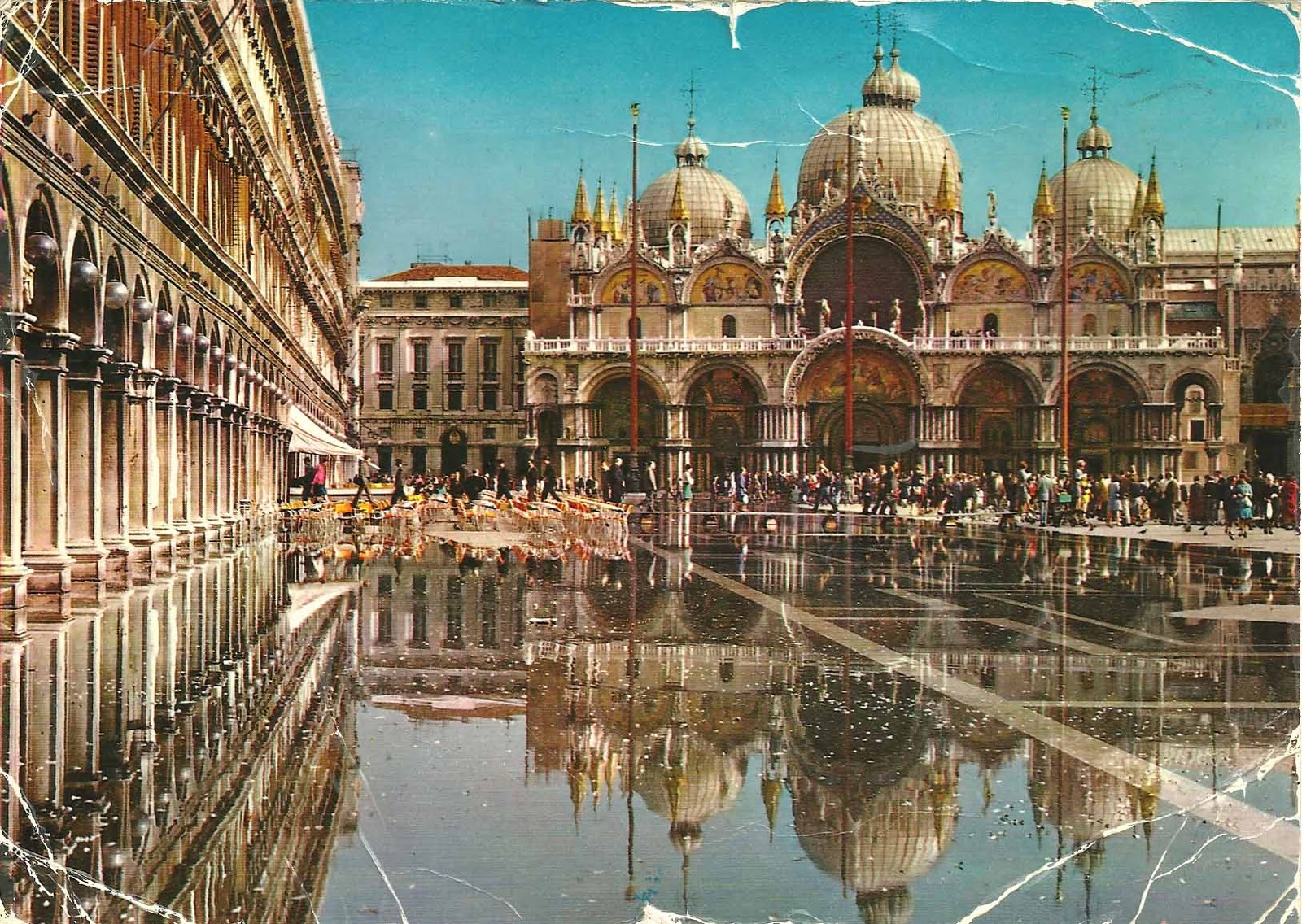
Piazza S. Marco, Venezia


A few days ago, I was having lunch with my mother and she gave me this card. It is in bad condition, but it is of great value to me because it was sent on 17 April 1971 from my mother and her sister to their father [my grandfather]. During that time there was military junta in Greece, that lasted from 1967 to 1974. My aunt and my grandfather have passed away, so this card brings me a lot of memories..

The card shows Piazza di San Marco during high tide (Acqua Alta). St Mark's Basilica (Basilica di San Marco in Italian) is the most famous of the many churches of Venice and one of the best examples of Byzantine architecture in the world. Located just off the Grand Canal, the gleaming basilica dominates Piazza San Marco (St. Mark's Square) and adjoins the Doge's Palace. San Marco is a cathedral: it has been the seat of the Archbishop of Venice since 1807.